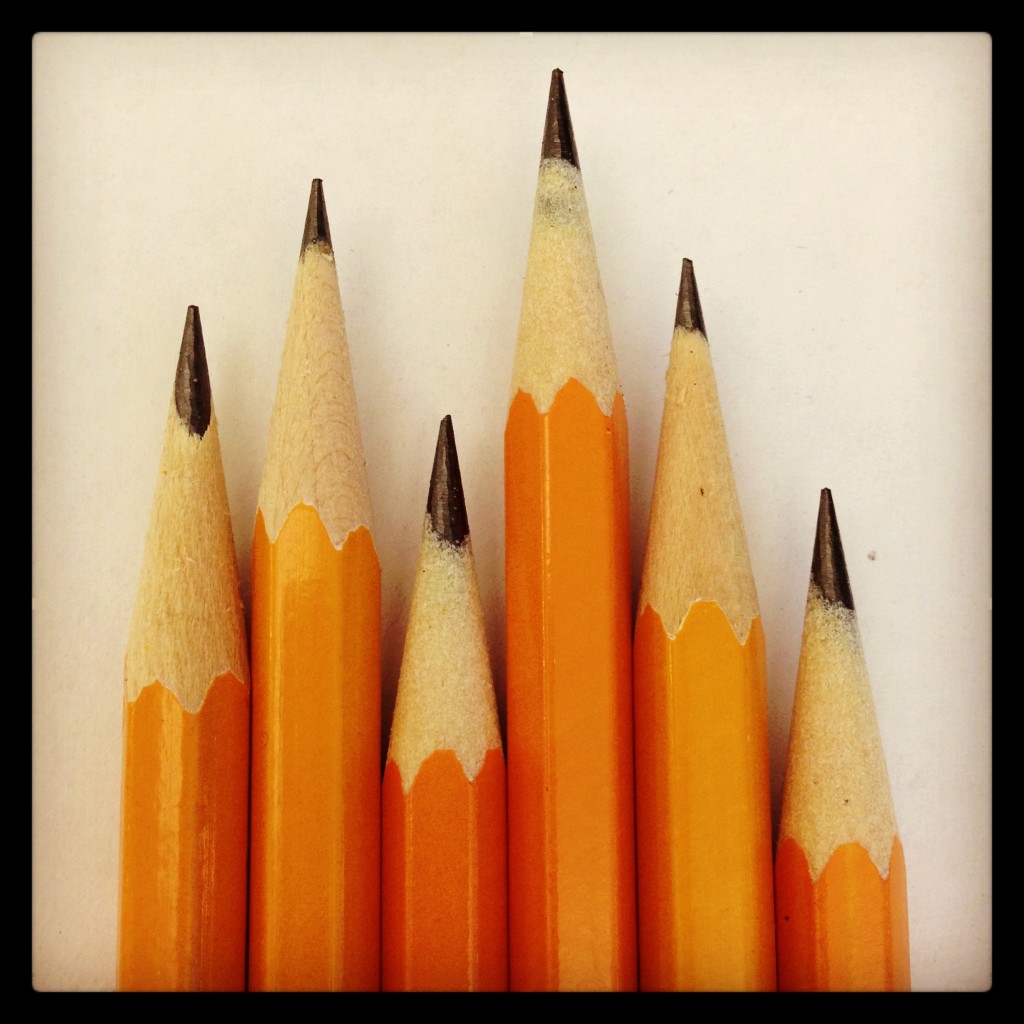
I rather like pencils. No, that's not right. I love pencils. You might think that it would be weird to ask for pencils for Christmas (which I did a few times), or save up my money to go down to the store and get a new pack, but they are the most necessary tool in my life. To me, a new pencil is like a shining blessing emerging out of the oblivion of scribbles, graphite smudges, and torn notebook paper. With each one, I treasure it like a diamond.
The pencils that I use have to be of a specific type, too. I absolutely refuse to use one of those pencils with the thin plastic layer of decorations on top, with the green and white erasers, even though there are oodles of them in my house. First of all, that isn't an eraser, that's a smudge creator. You would think that somebody who made pencils would want to maybe add an eraser on the top, but all there is is a thick, dry piece of rubber that either tears the paper or covers up the letters with so many smudge marks it's hard to read what it says in the first place. Second, nobody wants a pencil with an outside that peels off. It's horrible.
To me, the perfect pencil is either yellow or orange, and is nice and long, with an extremely sharp point at one end, and a soft eraser on the end. This eraser doesn't just make the writing hard to make out. It completely vanishes anything that it is put up to vanish, and doesn't wear away while doing so. The ones with the firm erasers are all right, too, but I prefer the softer kind. No matter which it is, though, I try to make it last for as long as possible. That's why I got mad at my classmates in Spanish when they tried to karate chop my pencils.
There's something about pencils that really just calls out to me. I don't know if it's the way that they just fit perfectly in your hand, ready for work, or the smooth texture. Maybe it's how they can write out an entire world just with simple strokes on a piece of paper, and create such powerful meaning. With the hand moving the right way, they can create the most elaborate pieces of art, whether in pictures or writing. Whatever it is, though, typing will never be the same.
Tuesday, April 30, 2013
Sunday, April 28, 2013
Just Look
I know that this is very controversial, but I found this thanks to my amazing friend Hermione, and I would like it if you would just take a look, and sign if you can/will. Thanks! And I will be posting something else soon, just not when I'm so...busy.
http://www.thepetitionsite.com/525/773/288/save-beatrizs-life-and-allow-her-abortion/?z00m=20544812
Friday, April 26, 2013
Thursday, April 25, 2013
Small Lessons Learned
Don't trust the Internet.
It's all right to have different interests, and not obsess over only one thing.
There's always a better violinist.
Bring a fork to school when you need one for lunch.
No matter how much you think your opinion matters, you shouldn't force it on someone else.
I don't have to be a novelist. There are other types of writing.
Tipping at a restaurant is 20%, not 10%.
I can speak better with adults than with other kids sometimes.
Sometimes the truth is so much better than your imagination.
Don't let your little brother set a cotton ball on fire.
Listen to Dumbledore and Gandalf. Old guys with white beards and big sticks are usually right.
Whether or not I realize it, criticism is one of the best things for you.
I don't want to have my life be all about clothes and gossip, like I see my friends in high school always talking about.
If you want to perfect something, you actually have to practice. It won't just happen by will.
It's all right to have different interests, and not obsess over only one thing.
There's always a better violinist.
Bring a fork to school when you need one for lunch.
No matter how much you think your opinion matters, you shouldn't force it on someone else.
I don't have to be a novelist. There are other types of writing.
Tipping at a restaurant is 20%, not 10%.
I can speak better with adults than with other kids sometimes.
Sometimes the truth is so much better than your imagination.
Don't let your little brother set a cotton ball on fire.
Listen to Dumbledore and Gandalf. Old guys with white beards and big sticks are usually right.
Whether or not I realize it, criticism is one of the best things for you.
I don't want to have my life be all about clothes and gossip, like I see my friends in high school always talking about.
If you want to perfect something, you actually have to practice. It won't just happen by will.
Tuesday, April 23, 2013
"Bad" Words: Why Our Society Makes Them So
About this time last year, I learned from my anglophile friend that in England, putting up your middle finger to somebody isn't particularly offensive. Instead, it's the peace sign, only backwards, so the outside of your hand is facing the person you're gesturing at. I, of course, had no idea of this at the time, and was surprised to hear that something as innocent and simple as turning your number two around could be so offensive to the people around you. I also hoped that no foreign team in the upcoming Olympics accidentally did it to the camera when they won second place.
As it turns out, so much of what we know here and today as offensive is totally different in other parts of the world, and the simple thing that we do are a shock to them. Making rude noises at the table might be a sign of gratitude in some countries, while in some languages, such as French, it can be perfectly acceptable to swear all the time, no matter where you are. A Brazilian exchange student I know slightly puts swear words totally out of context and distributes them sporadically throughout his language, but in Portuguese, apparently that's just the way it is.
I was thinking about this today, as I was listening to all of the dirty jokes and hushed profanity that was whirling around me at school, mostly in the sixth grade wing, where it's most common. And I started to wonder. What makes these words so bad that nobody can utter them without getting in trouble? Since when are simple letters put together so dangerous, and how did they get so much emotion implanted in them? The thing is, I'm sure that if we lived in a world where everybody just made up words all the time, we wouldn't have this problem. Once a word is given a definition, no matter how "bad" it seems, it builds up meaning as the years go by, like an organisms picking up parasites, or a rag collecting dust. The meaning will probably even change over time, and maybe go in and out of fashion, like clothes or entertainment sources.
These little secrets of different cultures, that are so hushed that nobody will tell you about them, are like the keys to unlocking the basic code of the world. One might visit another country paralyzed with fear, wondering what little movement could be considered offensive, or what is expected from guests. There are simple forms of etiquette that you need for other cultures, like wiping your feet or kissing in greeting, but then there are those crucial matters that you won't find anywhere, because it's so darn profane in that country. So how are we supposed to understand each other, and cooperate? Why must our societies be so different, and isolated from one another?
I've gotten much better at British slang and terminology (and have caught the anglophile fever myself), but there are still things in British media that I will see and have no idea what they heck it means. I'm careful not to stereotype, since it's definitely not true that all Americans follow the same rules and characteristics, but the idea that we're speaking a totally different language-even though it's the same dictionary-is mind boggling. If the Phoenicians had known what was going to happen to these basic letters and sounds when they put them together, they would have been shocked. But I guess that's society for you; always moving forward, at a greater speed than we would like, limiting what we do but writing out the basic code of culture for us. At least we're unique.
As it turns out, so much of what we know here and today as offensive is totally different in other parts of the world, and the simple thing that we do are a shock to them. Making rude noises at the table might be a sign of gratitude in some countries, while in some languages, such as French, it can be perfectly acceptable to swear all the time, no matter where you are. A Brazilian exchange student I know slightly puts swear words totally out of context and distributes them sporadically throughout his language, but in Portuguese, apparently that's just the way it is.
I was thinking about this today, as I was listening to all of the dirty jokes and hushed profanity that was whirling around me at school, mostly in the sixth grade wing, where it's most common. And I started to wonder. What makes these words so bad that nobody can utter them without getting in trouble? Since when are simple letters put together so dangerous, and how did they get so much emotion implanted in them? The thing is, I'm sure that if we lived in a world where everybody just made up words all the time, we wouldn't have this problem. Once a word is given a definition, no matter how "bad" it seems, it builds up meaning as the years go by, like an organisms picking up parasites, or a rag collecting dust. The meaning will probably even change over time, and maybe go in and out of fashion, like clothes or entertainment sources.
These little secrets of different cultures, that are so hushed that nobody will tell you about them, are like the keys to unlocking the basic code of the world. One might visit another country paralyzed with fear, wondering what little movement could be considered offensive, or what is expected from guests. There are simple forms of etiquette that you need for other cultures, like wiping your feet or kissing in greeting, but then there are those crucial matters that you won't find anywhere, because it's so darn profane in that country. So how are we supposed to understand each other, and cooperate? Why must our societies be so different, and isolated from one another?
I've gotten much better at British slang and terminology (and have caught the anglophile fever myself), but there are still things in British media that I will see and have no idea what they heck it means. I'm careful not to stereotype, since it's definitely not true that all Americans follow the same rules and characteristics, but the idea that we're speaking a totally different language-even though it's the same dictionary-is mind boggling. If the Phoenicians had known what was going to happen to these basic letters and sounds when they put them together, they would have been shocked. But I guess that's society for you; always moving forward, at a greater speed than we would like, limiting what we do but writing out the basic code of culture for us. At least we're unique.
Monday, April 22, 2013
Marching to the Beat of My Drum (Quite Literally)
As a classically trained violinist, I've mostly dabbled (what a funny word) in the random works of whoever Suzuki puts in their books, Mozart, Saint Saens, and Schubert, just to name a few. The fiddle part of Seven Brides for Seven Brothers was interesting enough, and quite a stretch for someone who's never seriously played something like that. In band, we usually attempt to play (not very well) middle school level pieces like Pirates of the Carribean, Portrait of a Clown, Winterwinds, etc., while concert band is much better, playing tons of Ticheli, like Vesuvius and Fortress, and even Wagner's Die Meistersinger. Still, I have never, ever marched in the marching band before. I have never ever marched in anything other than the marching band. That's why I was pretty nervous when I came to normal middle school band today, prepared with the three pieces we had been instructed to memorize, and took note of just how many of the high school band members had been excused from class to come and march with us. In short, all of them.
Apparently my band teacher had thought it was a good idea to put me in the front row when he was drawing out the diagram and put me there, right in the second file, and I hadn't gotten much from it when I got my copy a few weeks ago. Okay, I would be next to the best flute player in the entire band system, almost directly behind the drum major. That wasn't so bad. When I got to band today, though, I suddenly realized just how big the band was now. Usually, the high school pep band is roughly thirty people. Add fifteen willing seventh and eighth graders, you get forty five, plus the rest of our band, who marched along in the back just to practice. With the proper amount of space between us, we stretched from one end of the school to the other, from out on the street.
A marching band is divided up into ranks, which are the horizontal lines, and files, which are the vertical ones with a lot more people in them. Since I was in the first rank, second from the inside, I was leading the entire second file. What. For the first thirty minutes or so, all we did was mark time and practice fan turns, which have a really simple principle but are still hard to do with sixty scatterbrained kids. The entire time, thoughts were running endlessly through my head. What if get out of line? What foot do I put forward again? What's he doing now? *Trying to look out of the corner of my eye* What if I drop my flute? How many steps until the turn? Wait, is she out of line, or is everyone else behind her?
The other, and probably most important part of marching band is the actually music part. What non-bandies or those, like me, who have never tried it, it is actually really hard to play and walk at the same time. When you try it at home by yourself, it seems simple enough, but it's so much more than that. Not only do you have to keep your instrument steady, but you have to stay on the right foot, keep perfect time, have the music completely memorized, and be perfectly aware of what everyone else is doing, while trying not to trip on your giant shoes and faint from the heat in your suit. (Not that I've marched in the uniform yet, but so I've heard). And this is just walking down the street. During football games, the entire pep band goes out onto the field and spells out words like Win, Fight, and the mascot. Just like when I had to conduct band, I have so much more respect for these musical teenagers.
So what ended up happening in this thoroughly new and strange experience? Well, I didn't make a complete idiot of myself, at least. Yes, the freshman on my other side told me I was out of line once, and I had some trouble with the fan turn (until I realized that I had to take much slower steps), but other than that, it was fine. Just like in concert band, it was magically revealed to me that the members of the high school band aren't all prodigies (actually I think that only one of them really is, and it's obvious), and that their intimidating manners that scared me for two years were pretty much just the fact that they're tall and have big drums. The beat was off occasionally, and they kept on talking during stops, but the drum major even commented to the senior next to me that it was the first time in a while that the entire band was actually on the same foot. So I guess that overall it was a great addition to my musical repertoire (ha!). And I can't wait to do it again.
http://www.youtube.com/watch?v=3nhcTllJgIY
Because I mentioned it once and now it's stuck in my head.
Apparently my band teacher had thought it was a good idea to put me in the front row when he was drawing out the diagram and put me there, right in the second file, and I hadn't gotten much from it when I got my copy a few weeks ago. Okay, I would be next to the best flute player in the entire band system, almost directly behind the drum major. That wasn't so bad. When I got to band today, though, I suddenly realized just how big the band was now. Usually, the high school pep band is roughly thirty people. Add fifteen willing seventh and eighth graders, you get forty five, plus the rest of our band, who marched along in the back just to practice. With the proper amount of space between us, we stretched from one end of the school to the other, from out on the street.
A marching band is divided up into ranks, which are the horizontal lines, and files, which are the vertical ones with a lot more people in them. Since I was in the first rank, second from the inside, I was leading the entire second file. What. For the first thirty minutes or so, all we did was mark time and practice fan turns, which have a really simple principle but are still hard to do with sixty scatterbrained kids. The entire time, thoughts were running endlessly through my head. What if get out of line? What foot do I put forward again? What's he doing now? *Trying to look out of the corner of my eye* What if I drop my flute? How many steps until the turn? Wait, is she out of line, or is everyone else behind her?
The other, and probably most important part of marching band is the actually music part. What non-bandies or those, like me, who have never tried it, it is actually really hard to play and walk at the same time. When you try it at home by yourself, it seems simple enough, but it's so much more than that. Not only do you have to keep your instrument steady, but you have to stay on the right foot, keep perfect time, have the music completely memorized, and be perfectly aware of what everyone else is doing, while trying not to trip on your giant shoes and faint from the heat in your suit. (Not that I've marched in the uniform yet, but so I've heard). And this is just walking down the street. During football games, the entire pep band goes out onto the field and spells out words like Win, Fight, and the mascot. Just like when I had to conduct band, I have so much more respect for these musical teenagers.
So what ended up happening in this thoroughly new and strange experience? Well, I didn't make a complete idiot of myself, at least. Yes, the freshman on my other side told me I was out of line once, and I had some trouble with the fan turn (until I realized that I had to take much slower steps), but other than that, it was fine. Just like in concert band, it was magically revealed to me that the members of the high school band aren't all prodigies (actually I think that only one of them really is, and it's obvious), and that their intimidating manners that scared me for two years were pretty much just the fact that they're tall and have big drums. The beat was off occasionally, and they kept on talking during stops, but the drum major even commented to the senior next to me that it was the first time in a while that the entire band was actually on the same foot. So I guess that overall it was a great addition to my musical repertoire (ha!). And I can't wait to do it again.
http://www.youtube.com/watch?v=3nhcTllJgIY
Because I mentioned it once and now it's stuck in my head.
Sunday, April 21, 2013
The Musical Mind
It might have to do something with being tired or having really cold fingers, but today I couldn't play for the life of me. Both instruments, which use different parts of the body, different technique, and different style just wouldn't work for me. It's hard to believe that they're the same ones I created beautiful melodies with just the other day, but everything's the same except for me. Either something in my mind was disconnected, or somebody came and replaced my fingers overnight. Probably not the latter, but I still went from being the first violinist who apparently "had gotten a lot better over the year" back to, well, last year.
I know kids, fellow string players, who started out as young, enthusiastic players with lots of energy and a 1/4 size violin. Over the years, or even months, they gradually lost interest, and it became just another chore to practice, which can be a lot to a seven-year-old who doesn't care enough to actually put work into it. I watched as my friends-my inspiration, even-drifted away from the violin. The question always stood there, asked by parents and instructors. Do you want to keep on doing it? Of course I wanted to keep on doing it. It was the violin that mattered, not the kids who played it.
I started playing violin because I wanted to have music in my power. I knew about fiddles from my Little House on the Prairie enthusiasm, and the instrument seemed to easy to me. I was wrong, of course, but I still loved it. Sure, there were friends who influenced me along the way, but they weren't the only reason that I kept on playing. Where I live now there are hardly any string players compared to other places, but I still keep playing no matter how many there are. This question just seems so silly to me. Why would I stop? Does the social part of it matter that much?
When I was younger, I despised practicing sometimes. Like today, there would be times when the bow just wouldn't stay on the string, no matter how much rosin I put on or how firm my grip was, and I would get frustrated and exhausted. I couldn't see it at the time, but I realize now that it wasn't the violin's fault at all. It was me.
A violin is a piece of wood. That's pretty simple to understand. It is a hollowed out piece of wood with pretty designs on it and a few strands of metal stretched over it. By chance, it has the capability to play, but you can't just look at it and will it to do that. You have to have the gift that you put into it, and then produce what's all yours. In the beginning of math class this year all we learned about was input and output, and even though it annoyed me half to death, I'm still making analogies about it. Input: Skill. Output: Music. In sports, the ball won't move just because you want it to, it's because you have the physical energy to get up and kick the thing. If you have no will to pick up the instrument and play your heart out, do you think your music will be good?
And it's not only physical energy-it's the emotion of it, too. Time and time again I see violinists who just sit there holding the instrument, and bowing without any expression. There might be some vibrato in there, but for the most part it's just notes on a page. Every picture of a famous musician has some expression, not just a piece of wood on a shoulder. Input: Feeling. Output: Enrapturing melodies that resonate in every corner of the building.
When I see other musicians quit, it makes me so sad. I can understand if they hated it the whole time, but if they enjoyed the instrument, or even loved it, at one point, it should stay that way. Anything that could have happened to disrupt that must have been giant-a terrible incident, a broken arm, anything. Or maybe it was just the lost will to continue. When practicing becomes work, and hard labor at that, and the player forgets why he or she even started in the first place, it can't be blamed on the violin. It's the mind, and for the music to work, it must be the musical mind, which is set on one thing: giving it 110%.
By the way, I might be adding more pictures nowthat I learned how to do it. Enjoy the primitive version of amazing technology (that doesn't even make sense).
I know kids, fellow string players, who started out as young, enthusiastic players with lots of energy and a 1/4 size violin. Over the years, or even months, they gradually lost interest, and it became just another chore to practice, which can be a lot to a seven-year-old who doesn't care enough to actually put work into it. I watched as my friends-my inspiration, even-drifted away from the violin. The question always stood there, asked by parents and instructors. Do you want to keep on doing it? Of course I wanted to keep on doing it. It was the violin that mattered, not the kids who played it.
I started playing violin because I wanted to have music in my power. I knew about fiddles from my Little House on the Prairie enthusiasm, and the instrument seemed to easy to me. I was wrong, of course, but I still loved it. Sure, there were friends who influenced me along the way, but they weren't the only reason that I kept on playing. Where I live now there are hardly any string players compared to other places, but I still keep playing no matter how many there are. This question just seems so silly to me. Why would I stop? Does the social part of it matter that much?
When I was younger, I despised practicing sometimes. Like today, there would be times when the bow just wouldn't stay on the string, no matter how much rosin I put on or how firm my grip was, and I would get frustrated and exhausted. I couldn't see it at the time, but I realize now that it wasn't the violin's fault at all. It was me.
A violin is a piece of wood. That's pretty simple to understand. It is a hollowed out piece of wood with pretty designs on it and a few strands of metal stretched over it. By chance, it has the capability to play, but you can't just look at it and will it to do that. You have to have the gift that you put into it, and then produce what's all yours. In the beginning of math class this year all we learned about was input and output, and even though it annoyed me half to death, I'm still making analogies about it. Input: Skill. Output: Music. In sports, the ball won't move just because you want it to, it's because you have the physical energy to get up and kick the thing. If you have no will to pick up the instrument and play your heart out, do you think your music will be good?
And it's not only physical energy-it's the emotion of it, too. Time and time again I see violinists who just sit there holding the instrument, and bowing without any expression. There might be some vibrato in there, but for the most part it's just notes on a page. Every picture of a famous musician has some expression, not just a piece of wood on a shoulder. Input: Feeling. Output: Enrapturing melodies that resonate in every corner of the building.
When I see other musicians quit, it makes me so sad. I can understand if they hated it the whole time, but if they enjoyed the instrument, or even loved it, at one point, it should stay that way. Anything that could have happened to disrupt that must have been giant-a terrible incident, a broken arm, anything. Or maybe it was just the lost will to continue. When practicing becomes work, and hard labor at that, and the player forgets why he or she even started in the first place, it can't be blamed on the violin. It's the mind, and for the music to work, it must be the musical mind, which is set on one thing: giving it 110%.
By the way, I might be adding more pictures now
Subscribe to:
Posts (Atom)